
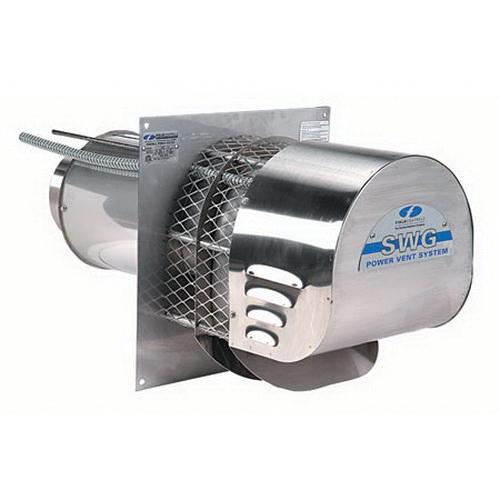

Field Controls SWG-5 46230000 Power Venter, 144 W, 3100 rpm Speed, 290000 Btu/hr BTU, Stainless Steel
- Manufacturer: Field Controls, LLC
- Brand Name: Field Controls
- Part#: FIESWGII5
- MPN: 46230000
- UPC: 090747187348
- Min. Order Qty: 1
- Qty. Interval: 1
-
 Available at All Branches
-
Price:
Gas and oil heating appliances generate heat through the combustion of fuel. The heat is transferred through the heat exchanger and distributed to the conditioned space. The products of combustion, however, must be vented safely out of the structure. In a conventional chimney, venting is achieved by the natural lifting action of the hot combustion gas. New, efficient systems absorb more of the heat in the heat exchanger and produce lower temperature vent gas. Lower temperature gas does not rise as quickly or as reliably as in older, less efficient systems. Power venting or sidewall venting is more economical and safer than chimney venting. A power venter uses a motorized blower to vent the products of combustion. A power venter is interlocked with the appliance to ensure that proper draft is achieved before the appliance burner is activated.
Field Controls Power Venter, Model: SWG-5, 1.3 A, 115 V, 60 Hz, 144 W, 3100 rpm, 5 in Vent, 5 in Inlet, 290000 Btu/hr, 1.85 gph at 100 psi, 1.55 gph at 140 psi Flow Rate, Stainless Steel, 12-1/4 in H x 12 in W x 9-7/32 in D
| Amperage Rating | : | 1.3 A |
| BTU Rating | : | 290000 Btu/hr |
| Dimensions | : | 12-1/4 in H x 12 in W x 9-7/32 in D |
| Flow Rate | : | 1.85 gph at 100 psi, 1.55 gph at 140 psi |
| Frequency Rating | : | 60 Hz |
| Inlet Size | : | 5 in |
| Material | : | Stainless Steel |
| Model | : | SWG-5 |
| Power Rating | : | 144 W |
| Speed Rating | : | 3100 rpm |
| Vent Size | : | 5 in |
| Voltage Rating | : | 115 V |
- 100% negative pressure in the vent pipe for maximum safety
- Standard galvanized pipe can be used instead of expensive stainless steel
- No need to seal vent pipe joints, saving time and money
- Significantly longer vent lengths than positive pressure, direct vent systems
- The SWG recommended by major heating appliance
- Thermal protected
- Power vent and backing plate included
 Catalog